

They bonded over meatballs. Seventy years on, Lady and the Tramp continues to charm with its heartfelt animation and canine romance.
In June 1955, Disney released Lady and the Tramp, its 15th animated feature, and arguably one of the studio’s most mature and ambitious works of the era. As the company stood on the brink of major milestones—a groundbreaking new theme park, a hit television presence, and the cultural phenomenon of Davy Crockett—this heartfelt canine romance quietly debuted, making history as the first animated feature in CinemaScope.
Seventy years later, Lady and the Tramp remains a cornerstone of Disney’s golden age, and a film that animation legend Eric Goldberg once described as “one of Walt’s most complex and adult films.” From its sweeping widescreen visuals to its intimate character work, this 1955 classic makes a case for that, even as it reflects the sensibilities, and occasional blind spots, of its time.
The Story Behind Lady and the Tramp
The origins of Lady and the Tramp go back to the 1930s, when legendary Disney story artist Joe Grant first pitched the idea of telling a romantic tale from a dog’s perspective. Although Grant wouldn’t receive formal credit on the final film, his early sketches heavily informed the project. Walt Disney later blended Grant’s concepts with Ward Greene’s 1945 Cosmopolitan short story Happy Dan, the Cynical Dog, adding in personal touches from his own life, including the antics of his own dog.
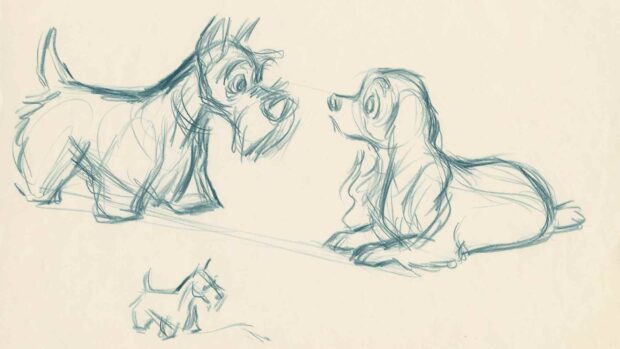
The setting—a turn-of-the-century American town—was deeply inspired by Walt’s childhood home of Marceline, Missouri. This nostalgic vision of early 20th century Americana, combined with the dog’s-eye narrative, created a world that felt both familiar and enchanting.
Unlike Disney’s earlier animated features rooted in European fairy tales, Lady and the Tramp was more grounded. The romance between an upper-class cocker spaniel and a streetwise mutt plays like a screwball comedy straight out of the Frank Capra era. Animator Andreas Deja once called it “a soap opera.” Just add spaghetti.
Bringing the film to life was no small feat. Over 50 storyboards and more than 1,000 concept sketches were produced. The team even compiled a brochure of nearly 200 dog breeds as inspiration for character design. The animators carefully crafted distinct personalities, from Jock’s Scottish pride to Trusty’s lumbering gait—his design influenced by British character actor Nigel Bruce.

The biggest technical leap came with Disney’s decision to make this the studio’s first animated feature in CinemaScope, an anamorphic widescreen format 86% wider than standard. While the studio had experimented with CinemaScope in shorts like Toot, Whistle, Plunk and Boom (1953) and live-action films like 20,000 Leagues Under the Sea (1954), applying it to feature animation was uncharted territory. The expanded frame demanded fewer close-ups, more complex staging, and a complete rethink for layout artists. Characters now had to traverse a much wider canvas, giving Lady and the Tramp its simultaneously intimate and expansive feel. In other words, a perfect fit for its emotionally grounded narrative.
A dog’s-eye view of the world
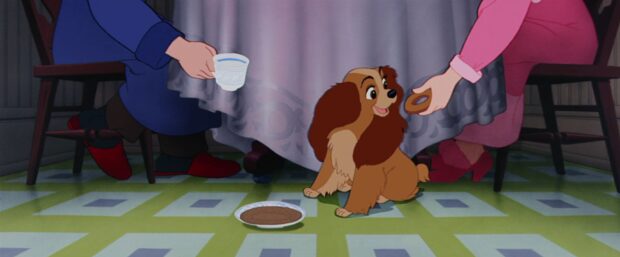
From the outset, the creative team made a conscious decision to tell the story entirely from the dogs’ point of view. Humans, though beautifully animated, are often seen only from the waist down, most notably in scenes with the ominous dog catcher. Animator Claude Coats even built scale models of the sets to help artists nail the low-angle perspective. It’s a kind of “Ozu-for-dogs” approach to animation.
The character animation remains among the finest of Disney’s mid-century output. Milt Kahl, largely responsible for Tramp’s animation, introduces the mutt with doglike tics and stretches that feel wholly authentic. Later, Tramp humorously mimics human behaviours, showing off Kahl’s expressive range. Fellow animator Frank Thomas’s work shines during the film’s thrilling rescue sequence, where light, shadow, and tension build masterfully as a rat creeps toward the baby’s crib.
Emotion anchored by spaghetti
If one image defines Lady and the Tramp, it’s the iconic spaghetti scene, a romantic moment that has inspired countless parodies and homages. Walt’s instruction to Frank Thomas was as simple as it was legendary: “Frank, I’ve got an assignment for you. We need to show the dogs falling in love while eating spaghetti.” Few scenes in Disney history so perfectly capture the studio’s ability to blend humour and tenderness.
That light romance sits comfortably alongside deeper emotional threads. The story team dug into Tramp’s backstory and “defensive psychology,” exploring how his carefree exterior masked loneliness and abandonment. This willingness to balance gags with genuine sentiment is what Walt praised, encouraging his team to have “the courage of their own convictions” and stay true to the emotional heart of the story.
“Frank, I’ve got an assignment for you. We need to show the dogs falling in love while eating spaghetti.”
Walt Disney
Even within its wide CinemaScope frame, Lady and the Tramp tells an intimate, character-driven tale. Like Dumbo and Bambi before it, Disney’s animators invite us to invest deeply in these animals’ lives. One especially poignant moment comes during the dog pound sequence, where the implied euthanasia of an unnamed stray plays out entirely in silhouette. It’s a quiet, devastating beat within a family film.
Walt was clear that he wanted to avoid any topical jokes or contemporary references that might disrupt the film’s period setting. Even the scene of Darling’s baby shower was carefully crafted with subtle hints—such as knitting and quiet staging—rather than overt mentions. “Don’t use the word ‘shower.’ That’s too obvious,” Walt instructed.
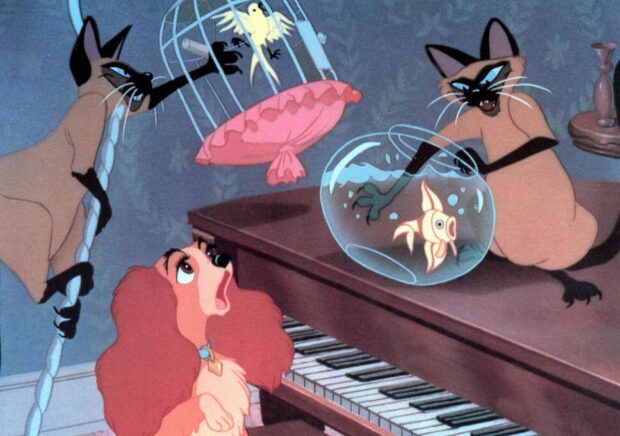
The film’s humour was designed to come not from gags, but from the dogs’ honesty and devotion. And yet, some characters did not escape broad caricature. Jock’s Scottish affectations are played for laughs, and voice actress Peggy Lee—who co-wrote and performed several songs—leans heavily into racial stereotypes when voicing the infamous Siamese cats, Si and Am. “I think it calls for a certain kind of Oriental rhythm,” Lee remarked in a behind the scenes special, right before delivering the exaggerated ‘We Are Siamese’ number. It’s no surprise that Disney dropped this scene from the 2019 remake.
Why Lady and the Tramp still matters in 2025
Seventy years on, Lady and the Tramp stands as one of Disney’s most visually elegant and emotionally resonant animated films. It showcases the full range of the studio’s mid-century artistry, from Claude Coats’ detailed layouts to Frank Thomas and Milt Kahl’s expressive animation, all set against Eyvind Earle’s gorgeous painted backdrops.
Yet, like many films of its era, it’s not without its flaws. The film’s racial and cultural stereotypes remain jarring for modern audiences, prompting Disney to include an appropriate content warning on Disney+. Acknowledging these contextual shortcomings is essential, even as we celebrate the film’s enduring artistry.
Lady and the Tramp remains a masterclass in emotional storytelling, a film that demonstrates just how deeply a well-told story, even one told from four paws and a tail, can resonate with us humans. That single spaghetti strand, shared beneath the stars, endures as one of cinema’s most iconic romantic images. Whether revisiting it on Disney+ or introducing it to a new generation, Lady and the Tramp remains an undeniable part of Disney’s rich legacy.