

A forgotten Disney drama, a daring horse evacuation, and a slice of World War II history you won’t (currently) find on Disney+.
While the title might sound like it belongs to an adult film aimed at a very particular niche demographic, Miracle of the White Stallions (1963) is actually based on the true story of Operation Cowboy: the daring evacuation of 70 Lipizzaner horses from the Spanish Riding School in Vienna during the Second World War. Yes, it’s another Disney horse film, but far more captivating than that label suggests. And since it does feature Nazis, you might not be entirely off base.
A distinct tonal shift from the theatrical Disney films of the era — largely taken up with high-concept comedies and coming-of-age pictures — Miracle of the White Stallions is something else entirely. Eschewing the traditional rep company of players, veteran actor Robert Taylor (in his first and only Disney picture) gives a convincingly dramatic turn as the historical Alois Podhajsky, the real German horseman and dressage expert, under the direction of relative newcomer Arthur Hiller.
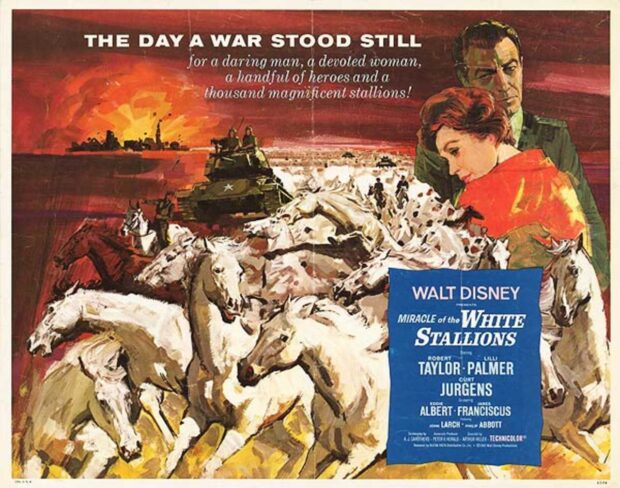
Structurally, director Hiller and screenwriter A.J. Carothers (working alongside the real Podhajsky) divide the film into two distinct sections. The first half sees Podhajsky confronting the bureaucracy of the Nazi regime as he tries to keep the horses alive during the assault on the city. Podhajsky’s desperate efforts aim to shield the Lipizzaner stallions from starvation, shelling, and potential seizure by the advancing Soviet army.
When Vienna becomes impossible to hold, he pleads with Allied forces to rescue the horses before they are lost to war. Facing suspicion from all sides — and with precious time running out — Podhajsky must convince the Americans to risk a mission to transport the horses to safety, culminating in a tense but ultimately uplifting evacuation.
The real Operation Cowboy, on which the film is based, is one of those wartime episodes so unlikely it feels ripped from an adventure magazine. In May 1945, American troops, working side by side with surrendered German soldiers and Austrian caretakers, evacuated prisoners of war along with hundreds of Lipizzaner and other prized horses from Czechoslovakia to keep them from being seized (or worse) by the advancing Soviets. Podhajsky even met with General George Patton (portrayed here by John Larch) — himself a devoted rider and former Olympian — who agreed to the operation. It was a surreal moment of international cooperation, and Disney wisely recognised it was a ready-made horse movie, just waiting to be saddled up.
Podhajsky even met with General George Patton…who agreed to the operation.
As the mission to save the horses enters its final, desperate phase, the film pivots decisively into a more traditional war picture, complete with tense battle imagery and high-stakes action. Here we see something truly different for a Disney film: direct references to the camps, jeeps and tanks rolling out, trains being attacked by dive-bombing planes, and explosions erupting around the actors. It’s the kind of war imagery more likely associated with the live-action prestige pictures of studios like MGM or 20th Century Fox.
Disney, meanwhile, had spent the preceding decade building a reputation on raccoons, leprechauns, and lost suburban puppies, so the grittier realism on display here feels downright radical by comparison. The visuals aren’t just confined to the battlefield, either. German cinematographer Günther Anders makes striking use of dramatic interior shots, adding to the film’s impact (though it’s worth noting the asterisk in his career: he was considered one of the top cameramen in the Third Reich).
Miracle of the White Stallions may seem like a relatively minor entry in the Disney canon, especially when the New York Times dismissed its first half as “exhaustingly routine.” Yet it remains surprisingly engaging for the duration, indicative of a studio yearning to break free from the box it had often painted itself into. Yet today, Miracle of the White Stallions barely registers among even hardcore Disney buffs, let alone mainstream audiences — and predictably, you probably won’t find it galloping onto Disney+ any time soon. Still, it stands as a reminder that the House of Mouse sometimes took far bigger risks than it’s usually given credit for.
MORE FROM DISNEY MINUS: Newman Laugh-O-Grams | Walt’s first fairy tales | Alice Comedies | Oswald the (Un)lucky Rabbit | Silly Symphonies | The Spirit of 1943 | So Dear to My Heart | One Hour in Wonderland | The early lost films | Johnny Tremain | Westerns of the 1950s | Moon Pilot | The Horse Without A Head | The Miracle of the White Stallions | Lt. Robin Crusoe, U.S.N.