

I first saw Back to the Future in cinemas in 1985 at the tender age of six. It wasn’t my first movie, and clearly not my last, but something changed in me that day. My density had brought me to it.
In the decades since, I’m sure I’ve seen it more than a hundred times. And yet, every time the DeLorean hits 88 miles per hour, I still feel that same electric thrill.
Through sequels, spin-offs, cartoons, video games, and even a Broadway musical, Back to the Future has grown with me, all without changing a single second of footage. It’s a period piece and a perfect bubble of 1980s pop culture — the combination of which makes it oddly timeless. Whether I’m watching it with a packed cinema audience or revisiting it on a pristine 4K disc, it still finds new ways to surprise me.
It’s a coming-of-age film that wrestles with fate, commercialism in Reagan’s America, and dances (quite literally) around incestuous undertones. It’s a sci-fi story that’s somehow both a love letter to mid-century values and a sharp skewering of them. It’s strong and it’s sudden and it’s cruel sometimes, but it might just save your life. That’s the power of love.

Why not do it with some style?
So, where does one start when writing about one of their favourite films? Probably the same place most films start: with director Robert Zemeckis and Bob Gale’s screenplay. The Used Cars duo began developing it as early as 1980 with a simple idea — would a teenager get along with his own father if they went to school together?
After multiple developmental iterations — Doc Brown (ultimately played by Christopher Lloyd) as a video pirate, the time machine strapped to the back of a truck and driven into a nuclear explosion, alternate versions where Marty’s father becomes a boxer — Back to the Future finally settled into the film we know today.
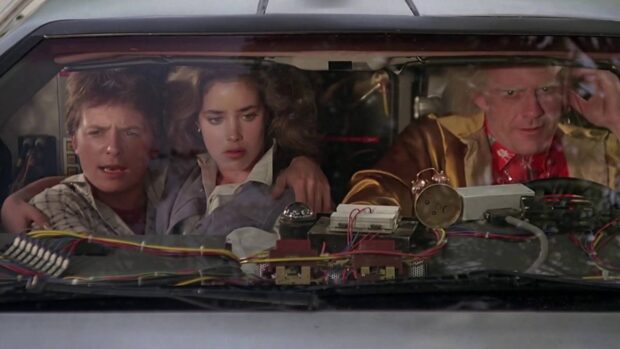
The screenplay by Zemeckis and Gale is arguably one of the tightest structures written for a modern summer blockbuster. Teenager Marty McFly (Michael J. Fox) accidentally travels from 1985 to 1955 in a DeLorean time machine built by his eccentric friend Doc Brown (Lloyd). Stranded in the past, Marty inadvertently disrupts his parents’ (Crispin Glover and Lea Thompson) first meeting and must find a way to repair the timeline, ensure his own existence, and return to the present. He enlists the younger Doc’s help to harness a lightning strike as the only power source capable of sending him back to the future.
What’s striking watching this today, when the average summer blockbuster runs well over two hours, is the sheer economy of storytelling in a 116-minute package. Every scene serves a purpose, and every beat pays off. The Twin Pines Mall becomes the Lone Pine Mall after Marty runs one over in 1955. The fading photograph serves as a ticking clock for added tension.
And the iconic Clock Tower sequence remains one of the most tightly edited action set-pieces ever put on film. “You’ve got less than four minutes!” Doc yells, as Marty races off to the starting line. As the film cuts between Marty driving, Doc dangling, and that eternally ticking clock, each edit throws up another minor catastrophe, a miraculous save, and a literal lightning crash of a solution.
Even after seeing it as many times as I have, I’m still on the edge of my seat wondering whether Marty’s going to make it. He does — in almost exactly four minutes.
Hello? McFly? The cast that makes it sing
Of course, even the tightest screenplay falls flat without the right cast. Back to the Future couldn’t have landed a more perfect ensemble.
Michael J. Fox, brought back in after the now-famous Eric Stoltz recasting, injects Marty with a kinetic energy that carries the entire film. His effortless charm makes the increasingly absurd situation feel somehow plausible. It’s all the more impressive when you realise his on-screen exhaustion is genuine: he was burning the candle at both ends while filming the hit TV show Family Ties at the same time, the very scheduling conflict Stoltz had originally been hired to avoid.
Alongside him, Christopher Lloyd’s Doc Brown is a gloriously unhinged blend of wild-eyed genius and childlike excitement, the sort of character who really would invent a time machine after slipping off a toilet. Lea Thompson and Crispin Glover give the film unexpected emotional weight, playing both their teenage and dual middle-aged selves with nuance and pathos that’s easy to overlook beneath the more obvious comedy.
We don’t need roads: a film that grows without changing
In the decades since its release, Back to the Future has become more than just a beloved film. It’s a cornerstone of pop culture. The DeLorean, the flux capacitor, “88 miles per hour”, “Great Scott!”, “1.21 gigawatts!” — they’ve all entered the cultural lexicon. It spawned two sequels, an animated series, video games, a theme park ride, and even a Broadway musical, each adding new layers to the mythology while leaving the original film untouched. Rick and Morty owes its origin story to the Doc and Marty dynamic. Few films have cast a shadow this long or remained quite so universally recognisable.
Two years ago, I was lucky enough to see the musical adaptation on the West End in London. The six-year-old in me stared up, goggle-eyed, at the lavish production design, the on-point casting, and the remarkable live effects for the DeLorean. It works because it’s reverential to the original, but smart enough to know that simply recreating it wasn’t enough. There’s a scene where Doc Brown dreams about the 21st century — but even that outlandish vision couldn’t have predicted the phenomenon to come.
The original resonates because it was never just about time travel. Beneath the sci-fi façade is a story about family, second chances, how small towns change over time, and finding your place. It was a 1980s high-concept gamble that happened to be bright and endlessly quotable, but it stubbornly refuses to give in to the cynicism of the Reagan era. Even as it pokes fun at both 1955 and 1985, there’s a sincerity at its core that’s harder to find in today’s blockbusters. It’s that rare thing: a big, crowd-pleasing film that’s both incredibly clever and completely heartfelt.
Good night, future boy!
Forty years later, I know every line by heart. I can hear the whir of the DeLorean engine before it even starts. If I could travel back in time and tell my six-year-old self that I’d be writing about the film for its 40th anniversary, he’d probably react much the way 1955 Doc Brown did — and demand to know who the US president was in 2025.
Every time I sit down to watch Back to the Future, just as I did days before hitting publish on this piece, it always feels new again. Zemeckis and Gale wove timelessness into a film about time.
Roads? Where we’re going, we don’t need roads. I don’t even have a licence to drive. But I’ll happily keep coming back to Hill Valley in 1955, 1985, 2015 – or 2055.