

So, picture this. You’re sitting in a cinema in 2005. It’s a full three years before Iron Man, let alone any hint of a cinematic universe.
Yet comic book movies are already hot property. Blade had just completed his trinity. Spider-Man 2 came about as close to perfection as we could hope. Fox’s Daredevil and Elektra proved a mixed bag, but the studio hoped they could recapture the team magic of X-Men and its sequel.
Now, on the occasion of the 20th anniversary of Tim Story’s Fantastic Four (2005), we’re only weeks away from a rebooted First Family entering the MCU. In the two decades since, we’ve had a sequel to Story’s film, a misguided Josh Trank version, and multiple attempts to get the formula right.
But back in 2005, Fantastic Four was all about having fun. It’s a joyfully cast throwback that eschewed the darkness of its contemporaries and seemed poised to launch a franchise. Or so we thought.
The rocky road to the Baxter Building
Fantastic Four (2005) had a long and strange journey to the screen, one as rocky as Ben Grimm’s backside. Producer Bernd Eichinger first acquired the rights in 1986 after several years of negotiations, and to retain them, famously commissioned a low-budget 1994 version with Roger Corman. It was never officially released, and it’s been now well documented that it existed solely to keep the licence.

Over the next decade, the project cycled through studios, scripts, and directors, and the word of Yancy Street is that this included Chris Columbus, Raja Gosnell, Sam Weisman, and future Ant-Man director Peyton Reed. At one point, even actor Sean Astin pitched himself as director, singer Christina Aguilera was floated as Sue Storm, and Robert Downey Jr. was considered for Doctor Doom. (But more on that later).
Tim Story was finally hired in 2004 after Fox was impressed with his cut of Taxi. The final cast — Ioan Gruffudd as Reed Richards, Jessica Alba as Sue Storm, Chris Evans as Johnny Storm, Michael Chiklis as Ben Grimm, and Julian McMahon as Doom — was locked in, and Story made significant changes after seeing Disney/Pixar’s The Incredibles to avoid inevitable comparisons. After nearly two decades in development hell, Fantastic Four hit cinemas in 2005.
It’s the cosmic rays!
Like all the best comic book characters, the Fantastic Four’s origin story has changed very little over the last 60 years, and screenwriters Mark Frost (Twin Peaks) and Michael France (Hulk, The Punisher) do very little to alter that.
You probably know the drill by now. A team of four astronauts gain extraordinary powers after a cosmic cloud hits their space mission. Reed Richards gains the ability to stretch his body, Sue Storm becomes invisible and can generate force fields, Johnny Storm can engulf himself in flames and fly, and Ben Grimm transforms into a rock-like strongman.
As they learn to control their newfound abilities, Dr Victor Von Doom, CEO of Von Doom Industries and a brilliant but vengeful scientist who also got caught in the accident, turns to the darker side of his powers and ultimately threatens the Four, New York City, and the world.
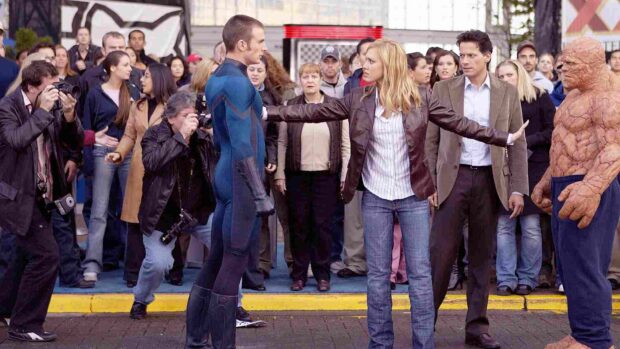
Flame on, again
Even amongst all the late ’90s and early 2000s silliness, Story’s take on Fantastic Four offers a rare bit of joy. Structurally, the film wastes no time getting to the origin story, neatly tying the team’s transformation and the villain’s downfall into one fell swoop. Sure, New York might be a little too quick to embrace its newest costumed celebrities, but it gets us to a place where we can hit the ground running.
The film then spends a surprisingly long stretch simply playing around with its characters and their quirks, a luxury few modern blockbusters afford themselves in such a plot-driven environment. Yes, that means the final act arrives rather suddenly, but we’ve had a damn fine time getting there.
There’s some occasional tonal whiplash between jokey moments and drama, but so much of this feels like a capsule in time. The choice to portray the Thing entirely with a practical costume is retroactively refreshing, Chris Evans’s cheeky charm as Johnny Storm wonderfully contrasts and compliments the earnest Captain America he would play six years later, and the stakes hit a sweet spot that’s neither too high nor too low. It’s very much a film for the MTV generation, man!
A fantastic legacy?
How quickly things changed. The sequel, Fantastic Four: Rise of the Silver Surfer, landed in 2007 — after the triple whammy of X-Men: The Last Stand, Ghost Rider and Spider-Man 3 — so audiences may already have been wary.
Gleefully paving over its own plot holes (chiefly the sudden reappearance of Doom), the sequel’s bigger crime is its treatment of Galactus as an amorphous cloud. (DC’s Green Lantern would make a similar mistake in 2011 with the yellow Parallax blob — though at least that one had a face). Still, one of Marvel Comics’ most iconic characters and storylines was squandered, much like the Dark Phoenix Saga the year before in X-Men. Which is a shame: the FF themselves remain fun, the character interplay is pitched just right, and the power-swapping gag is a clever touch, if somewhat underused.
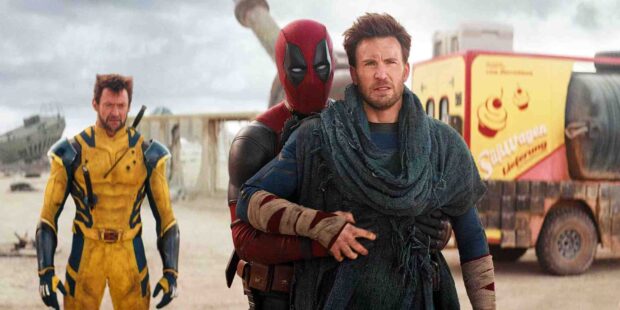
The following year, the course of Marvel movies changed forever. Iron Man and The Incredible Hulk launched the Marvel Cinematic Universe and, at the time of writing, it has produced 36 films and counting. Chris Evans became one of its defining stars as a completely different character, though he made a cheeky cameo in Deadpool & Wolverine (2024) to give Johnny Storm a spectacular send-off. Now, nearly two decades later, the Fantastic Four are finally ready to enter the MCU properly: a full-circle moment if ever there was one.
Here’s hoping for a bright future for the new FF. Otherwise, it’s clobberin’ time. It’s catchy, right?