
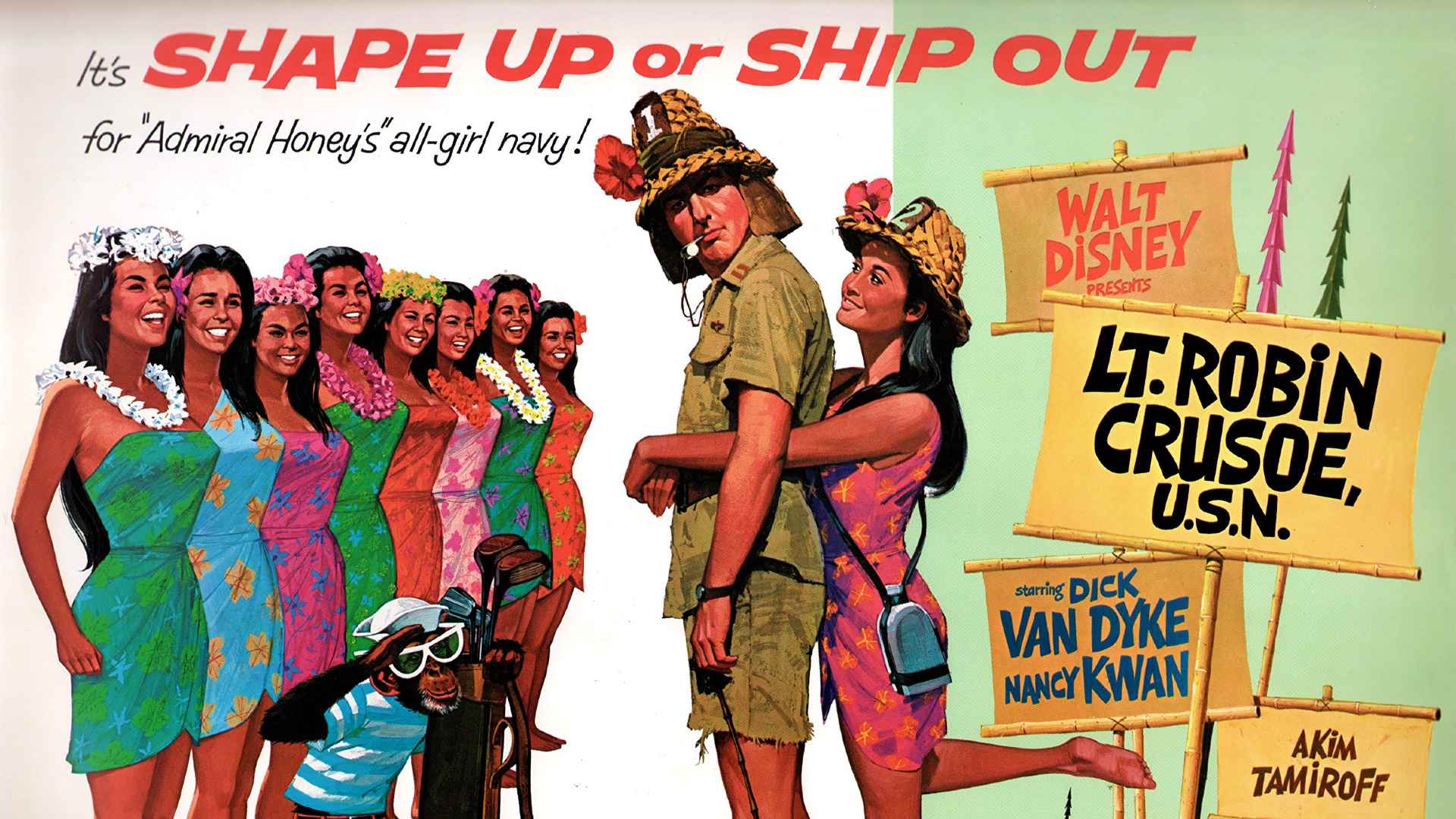
Dick Van Dyke’s charm can’t save this tone-deaf island romp, where slapstick, sexism and stereotypes run aground in Disney’s post-Mary Poppins slump.
It’s no wonder Disney keeps circling back to Moana and Lilo & Stitch. After Lt. Robin Crusoe, USN, the studio owes the entire Polynesian cultural landscape repeated apologies.
Disney had enjoyed a mighty couple of years: Mary Poppins (1964) had become the studio’s biggest success to date, they were showcasing new technologies at the New York World’s Fair that would soon expand Disneyland, and The Wonderful World of Color remained a top‑rating television staple. Yet by the time Lt. Robin Crusoe, USN rolled around in 1966, the studio was already struggling to keep its adult audience engaged with a string of lightweight live‑action comedies.
Van Dyke was in the midst of a three‑picture run with Disney off the back of Mary Poppins’ success. The Dick Van Dyke Show had just ended its celebrated run, and here he takes the lead in what’s essentially a modernised version of Daniel Defoe’s classic 1719 novel Robinson Crusoe. The titular U.S. Navy pilot finds himself stranded on a remote island with only a chimp named Floyd for company and a beautiful island inhabitant he dubs Wednesday (Nancy Kwan).
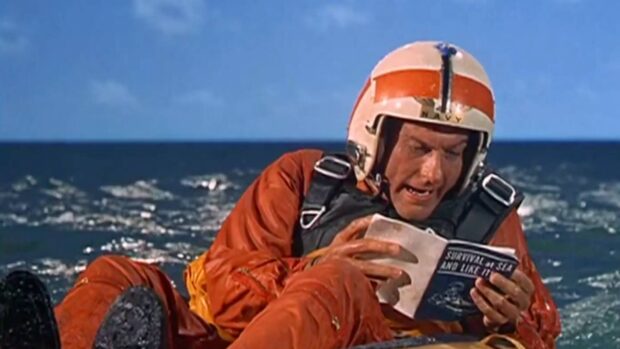
But screenwriters Don DaGradi and Bill Walsh lean far too heavily on Van Dyke’s singular charms. For the first fifteen drawn‑out minutes, we’re simply treated to him bobbing aimlessly in a rubber dinghy. It plays like a bloated Goofy “How‑To” cartoon, complete with fourth‑wall winkers, Richard Deacon’s narration, and absurdly bad shark effects. The episodic structure makes sense given director Byron Paul’s television background, which included Disney’s youth‑oriented For the Love of Willadean, the western serial The Tenderfoot, and kid‑detective series The Adventures of Gallegher.
Even so, this opening hints at the film’s cultural tone‑deafness, peppered with casual racism and stereotypical jokes that only set the stage for worse to come.
“Sailors do not giggle.”
Once Crusoe reaches the island, the film devolves into cartoonish antics: an elaborate mailbox slide for message bottles, a chimp wielding tools, Dick riding a fire‑hose gallantly like a ’30s toon hero. It all sounds like a great barrel of fun on paper, but Lt. Robin Crusoe, USN often finds its comedy in othering so-called ‘exotic’ locales and people.
This sits alongside Disney’s other “exotic locale” films, like In Search of the Castaways before it and The Castaway Cowboy almost a decade later. Disney is not alone in treating non‑Western settings as comedy backdrops rather than meaningful places, but there’s some especially egregious examples here.
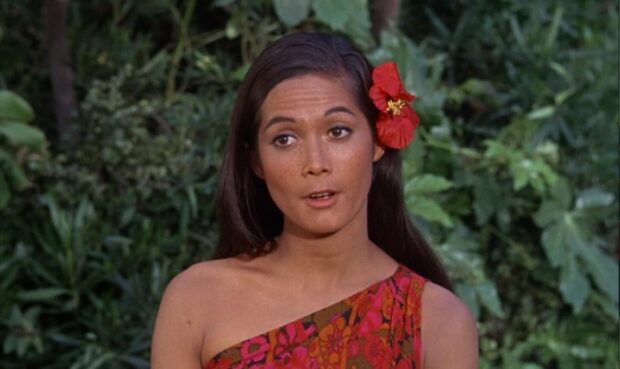
Kwan’s “Wednesday” is a clumsy attempt to fuse Polynesian stereotypes with mid‑’60s second‑wave feminism. Though Kwan’s timing is sharp, and Van Dyke, overwhelmed by what eventually becomes an island full of women, has its laughs, the net effect lands as tepid at best, mocking at worst. Worse still is Russian‑American actor Akim Tamiroff’s “chief Tanamashu”—a caricature plunging the film into offensively broad territory.
Monkeys at last
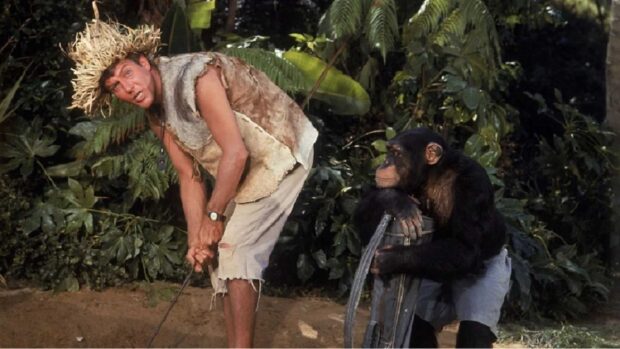
In the past, I’ve lamented that Disney’s so-called “monkey movies” often lack sufficient monkeys. Moon Pilot, I’m looking at you. On the simian level at least, this one delivers, with Floyd the chimp taking charge—often wielding a gun or a sword—and carrying the requisite primate charisma.
The climactic fireworks inside the temple‑like stone head visually nod to The Wizard of Oz, leaning heavily on the gag-driven nature of the film. It’s another hark back to the origins of cartoons, when Disney would pay bonuses to story artists who came up with the most on-screen gags. In other words, this film is built almost entirely around “bits” every few minutes rather than a strong narrative arc. It’s a TV-style episodic structure, similar to other live-action comedies of the era like The Misadventures of Merlin Jones and its sequel The Monkey’s Uncle.
On a technical level, there are some pleasant surprises. The animated fireworks effects during the finale are surprisingly effective, and Peter Ellenshaw’s matte paintings—especially the Japanese submarine—are up to his usual high standards.
An awkward legacy
Today, this film languishes in the footnotes of Disney history—despite the tragic fact that cameraman Robert King Baggot (son of actor/director King Baggott) lost his life in a boating accident during production, with Ellenshaw himself also imperilled.
Adding to the absurdity, the film was produced with the cooperation of the U.S. Navy, whose endorsement feels baffling in hindsight. And here’s a final fun fact to lighten the mood: this is the only film where Walt Disney received a story credit as “Retlaw Yensid.” After watching this, I’d probably want to change my name in the credits too.
Which leaves the question of who this film is for today. It’s for Disney completists, archival curiosity seekers, or Dick Van Dyke obsessives trying to hit 100% on Letterboxd. For everyone else, this is a clumsy mix of slapstick, sexism, and cultural insensitivity that even the era’s lax norms struggle to justify.
Disney continued these tropes well beyond Lt. Robin Crusoe, USN. The Enchanted Tiki Room in Disneyland has undergone many changes over the years, but its mid-century “tiki culture” roots remain clear. Disney’s Polynesian Village Resort opened in Florida during the height of the U.S. tiki craze in 1971, a romanticised version of Polynesia that still stands today.
It wasn’t until the 21st century—with Lilo & Stitch and Moana—that Disney finally took a more sensitive, consultative approach to Polynesian culture. The result has been more rounded and enduring stories that entertain without punching down.
MORE FROM DISNEY MINUS: Newman Laugh-O-Grams | Walt’s first fairy tales | Alice Comedies | Oswald the (Un)lucky Rabbit | Silly Symphonies | The Spirit of 1943 | So Dear to My Heart | One Hour in Wonderland | The early lost films | Johnny Tremain | Westerns of the 1950s | Moon Pilot | The Horse Without A Head | The Miracle of the White Stallions | Lt. Robin Crusoe, U.S.N.