
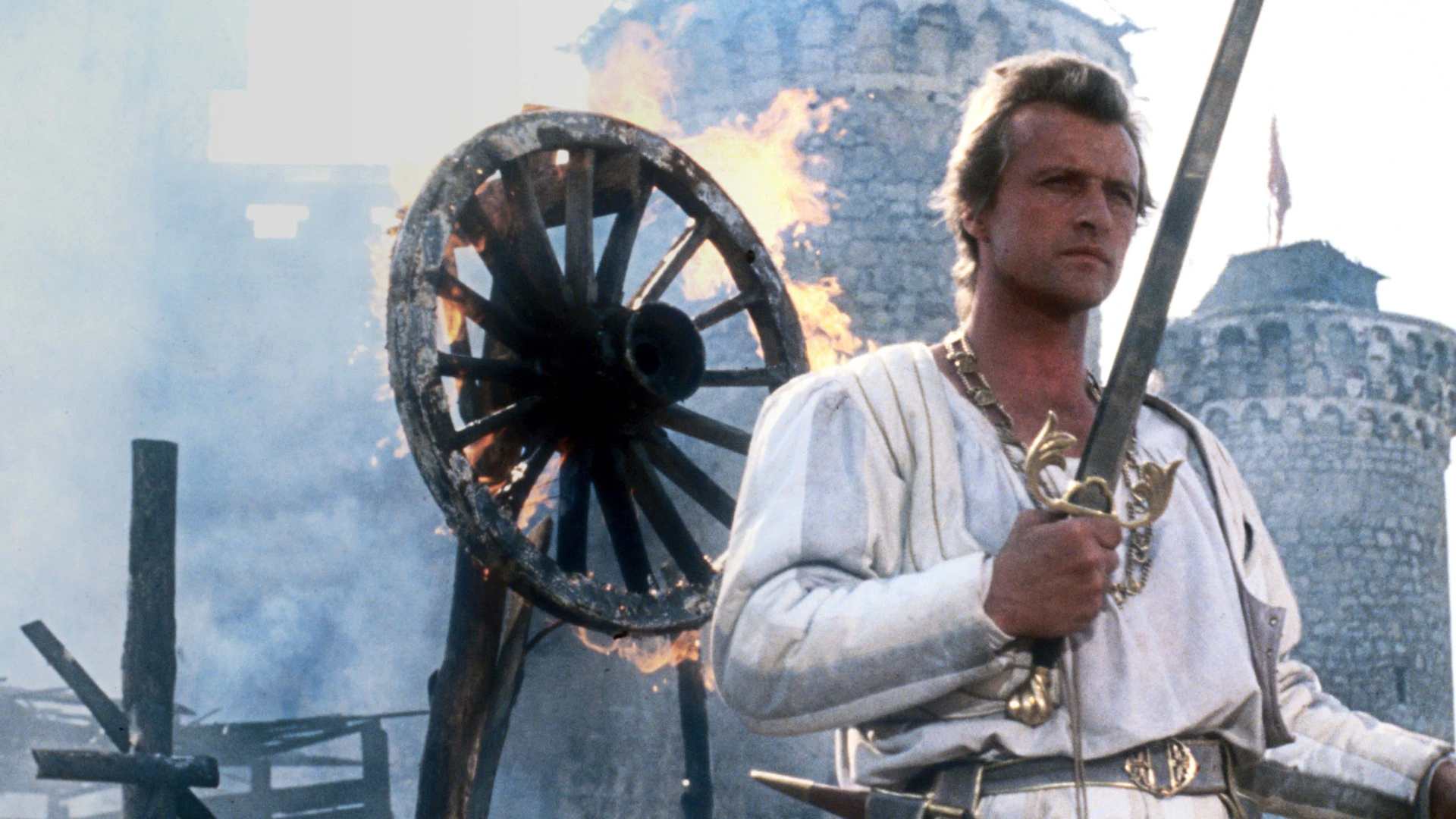
Forty years ago, Paul Verhoeven unleashed FLESH + BLOOD, a bawdy, brutal medieval epic that left audiences both horrified and fascinated—and hinted at the Hollywood blockbusters to come.
As Paul Verhoeven closed the door on the Dutch film industry following the controversial reception of Spetters, he and regular screenwriter Gerard Soeteman sought alternative funding beyond government subsidies. Hollywood’s Orion Pictures stepped in, setting Verhoeven on a path toward blockbuster filmmaking. Yet, FLESH + BLOOD, released forty years ago in 1985, proved that transition anything but smooth.
Set in 1501 amidst warring mercenaries and plague, the film draws on unused concepts from Verhoeven’s 1969 Floris TV series, also starring Rutger Hauer. In many ways, FLESH + BLOOD is a bawdy, violent, and sexually charged alternate history of those episodic tales, and an early showcase of the gory, explicit set-pieces that would become Verhoeven’s hallmark over the next decade.
The story itself follows a band of mercenaries led by Martin (Rutger Hauer) who, after noble lord Arnolfini (Fernando Hilbeck) refuses to pay them, take revenge by kidnapping Agnes (Jennifer Jason Leigh), the aristocrat betrothed to Arnolfini’s son Steven (Tom Burlinson). As plague and warfare do their thing across the land, the mercenaries lay siege to a remote castle, waiting for the full weight of the aristocracy to come down on them.
The film’s audaciousness is both one of its strength and its greatest weakness. Freewheeling chaos reigns, with a clash of American, Australian, British, and Dutch accents, and a level of excess that can barely be contained. Jack Thompson lances his own plague boils; Jennifer Jason Leigh’s extended rape sequence, even in censored form, is deeply uncomfortable, reflecting Verhoeven’s troubling frequent use of sexual assault as a plot device.
The drama behind the scenes bleeds into the film itself. A looser, improvisational approach to shooting coincides with growing tensions between Hauer and Verhoeven. According to Douglas Keesey’s 2005 book on the director, disputes over Hauer’s interpretation of his morally ambiguous lead — and Hauer’s desire to play more heroic leading men — contributed to their falling out. Conflicting anecdotes even suggest Hauer was considered too large for the RoboCop suit, in Verhoeven’s next film, adding to the mystique of this fifth and final collaboration. The result is a film that occasionally feels structurally adrift.
What makes FLESH + BLOOD especially fascinating today is how it explores the collision of faith and ambition, a theme Verhoeven would has revisited over the decades. Unlike the more reflective Benedetta or the psychological thriller The Fourth Man, this earlier work adopts a cynical view of human nature. For its lead actor, it slots neatly between Hauer’s roles in Floris, Blade Runner, and Ladyhawke, creating a curious two-lane bridge across European and Hollywood cinema.
Forty years on, FLESH + BLOOD may not have fully coalesced in its moment. With the benefit of hindsight, it’s easy to see why it didn’t all gel more easily, but it remains an essential marker in Verhoeven’s career—a bridge from European art-house sensibilities to Hollywood genre excess. For those who like their medieval swordplay bloody, morally murky, and populated by Dutch and Australian mercenaries, it remains a striking, unforgettable spectacle.
FLESH + BLOOD was released in US cinemas on 30 August 1985.
Note: This review was adapted from an earlier piece I wrote on Letterboxd in 2022.