
“In Mid-World, which this man called the Territories when he was a boy, there is a word for those bound together by fate and circumstance: ka-tet.”
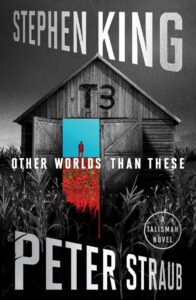
By the time Stephen King reached The Black House (2001), the sequel to his 1981 collaboration with the late Peter Straub, The Talisman, separate stories converging into a larger whole had become an increasingly central part of his fiction. Jack Sawyer, the hero of The Talisman, was now on a collision course with the Beam of The Dark Tower saga, the lightning rod that arguably acts as the backbone for all of King’s work. Indeed, the title of this latest work, Other Worlds Than These, is a phrase that has reverberated throughout King’s fictional universe since The Gunslinger.
When we left Jack a quarter of a century ago in Black House, he had been mortally wounded America-side and exiled to Mid-World. He can still visit America-side for brief periods before his wound catches up with him. Yet, as his ka-tet’s days dwindle, a new threat emerges, one that endangers both worlds. Or, more aptly, all worlds.
Jack accepts the call to the hero’s journey once again, this time to stop Roy Kinneston and Tara Lynne Speckhoffer, a violent, rampaging teen duo inspired by real-life spree killers Charles Starkweather and Caril Ann Fugate. Having begun their rampage America-side, they have brought their infection to the teenagers of Mid-World, aided by the mysterious “Gullet”, where an evil presence is reawakening.
There is a giddy joy for any of King’s Constant Readers in the opening pages of Other Worlds Than These. It’s not simply about revisiting a world we’ve come to love on so many levels. King’s plot- and character-driven prose has an easy way of enveloping us, and his ongoing sagas have a way of completely wrapping us in their warm embrace.
What King does so well is not simply plonk Sawyer down to walk in the footsteps of Roland Deschain, the Gunslinger and hero of The Dark Tower books. Yes, there is an element of that: after all, ka is a wheel. But the new characters – like Payton the fool and Mary the foul-mouthed recovering alcoholic, both from an America before Jack’s ‘when’ – are such beautifully realised archetypes plucked from King’s oeuvre that we feel as though we’ve always known them.
Yet memory is a funny thing, and the fuzziness of Jack’s recollection is central to Other Worlds Than These. King reluctantly uses the slightly cumbersome device of a diary written for his dead wife to recap key moments from The Talisman and Black House. But he doesn’t simply use it to jog our memory; he actively rewrites bits of Jack’s past to suit the current narrative. This has always been a minor feature of King’s series writing, with the details far more important to obsessives like me than they are to the central story. To be honest, had I not just reread The Talisman and Black House in anticipation of this book, I may not have noticed some of them.
Still, I’d be lying if I said I didn’t buzz with excitement and message my friend and fellow fan throughout whenever a deep pull to North Central Positronics was clocked or the number ‘19’ surfaced somewhere. Nods to previous books, stories like The Mist, and even Roland himself are consciously there for the Constant Readers. King gives us a kind of conclusion or coda for The Dark Tower devotees, albeit one that preserves all that is good about the original.
King is careful not to make this all about the past, even if ka dictates a certain fatalistic necessity to repeat it. Repetition is therefore central to the concept, and can occasionally threaten to drag in the middle. But the last third, structured around the Henri-Georges Clouzot’s Wages of Fear/William Friedkin’s The Sorcerer and bound by fate, is as tense and, dare I say, cinematic as anything King has written. Mind you, a curious meditation on AI in the last pages indicates King’s mind is never too far from the present.
You will be unlikely to be surprised by where Other Worlds Than These ends up, given everything I’ve said above. King brings the work he began with Straub to a satisfying conclusion, while nodding to a saga that King once said “actually contains all the others of my making.” Say thankya, Sai King.
2026 | US | WRITER: Stephen King and Peter Straub | PUBLISHER: Hodder & Stoughton | LENGTH: 880 pages | RELEASE DATE: 6 October 2026